
Gustav Klimt and Hokusai: Reframing Japonisme in Fin-de-Siècle Vienna
(See English below)
Am 17. September 2026 laden wir ab 18 Uhr zum Onlinevortrag von Svitlana Shiells ein, der unter dem Titel „Gustav Klimt and Hokusai: Reframing Japonisme in Fin-de-Siècle Vienna“ der Verbindung zwischen Gustav Klimt und Katsushika Hokusai auf den Grund geht und zeigt, wie tief die japanische Kunst das Schaffen des Wiener Secessionisten geprägt hat.
In fin-de-siècle Vienna, Japonisme became a Zeitgeist, and Gustav Klimt (1862-1918) was its most fervent advocate. Focusing on Klimt’s engagement with Japan, Svitlana Shiell’s research demonstrates that he not only collected Japanese art but also diligently and continuously studied it as a scholar. Accordingly, as Klaus Berger aptly observed: “there is hardly another artist who owes his self-realization to Japanese art as Klimt does; for without this particular note Klimt would not be Klimt.”
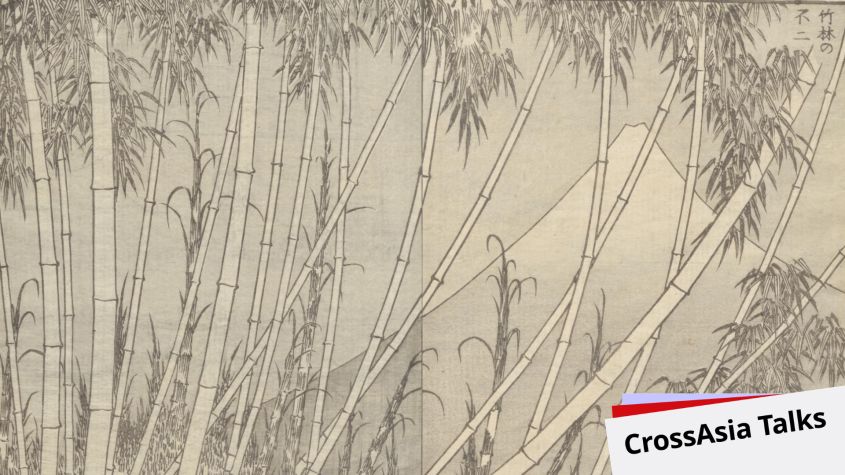
During the 1890s, Klimt developed a particular interest in ukiyo-e prints, especially the works of Katsushika Hokusai (1760–1849). The main Secessionist had numerous opportunities to examine Hokusai’s original prints and books, which were exhibited in Vienna in 1900, 1901, and 1903, as well as reproductions featured in a wide range of contemporary publications. A close analysis of Klimt’s oeuvre suggests that he carefully studied (and possibly even owned) some of Hokusai’s books, most notably One Hundred Views of Mount Fuji and the Hokusai Manga.
Generally speaking, the Hokusai Manga informed the West about Japan better and in a more fascinating manner than any travelogue and provided the most diverse source material for Western artists. Its impact on the latter was so overwhelming that, as one scholar put it, “one might be tempted to conclude that it was the only specimen of Japanese pictorial art available at the time.” Hokusai’s set was likely the source of ideas that enabled Klimt to develop witty and original compositions, exemplified by works such as Water Serpents I, Water Serpents II, Jurisprudence, Water Nymphs (Silverfishes), Danaë, Leda, and others.
Svitlana Shiell’s research further demonstrates that Klimt possessed an exceptional familiarity not only with Hokusai’s books and prints but also with his shunga. Providing Klimt with a broad range of formal ideas and even some motifs, Hokusai’s art remained a continual reference throughout his career. In short, while Klimt’s artistic pendulum inexorably oscillated between East and West, any rigorous analysis of Klimt’s oeuvre must account for the centrality of Japanese art—including Hokusai’s work—within his creative trajectory. Without doing so, it is impossible to grasp the intellectual depth, sophistication, and formal intricacies of Klimt’s oeuvre or his unprecedented ability to bridge East and West, ancient and modern.
Die Vortragssprache ist Englisch. Bei Fragen kontaktieren Sie uns unter: ostasienabt@sbb.spk-berlin.de.
Der Vortrag wird via Webex gestreamt und aufgezeichnet*. Sie können am Vortrag über Ihren Browser ohne Installation einer Software teilnehmen. Klicken Sie dazu unten auf „Zum Vortrag“, folgen dem Link „Über Browser teilnehmen“ und geben Ihren Namen ein.
Alle bislang angekündigten Vorträge finden Sie hier. Die weiteren Termine kündigen wir in unserem Blog und auf Mastodon-Account und BlueSky an.
—
On 17 September 2026, from 6 pm, we invite you to an online lecture by Svitlana Shiells, entitled “Gustav Klimt and Hokusai: Reframing Japonisme in Fin-de-Siècle Vienna”, which explores the connection between Gustav Klimt and Katsushika Hokusai and demonstrates the profound influence that Japanese art had on the work of the Viennese Secessionist.
In fin-de-siècle Vienna, Japonisme became a Zeitgeist, and Gustav Klimt (1862-1918) was its most fervent advocate. Focusing on Klimt’s engagement with Japan, Svitlana Shiell’s research demonstrates that he not only collected Japanese art but also diligently and continuously studied it as a scholar. Accordingly, as Klaus Berger aptly observed: “there is hardly another artist who owes his self-realization to Japanese art as Klimt does; for without this particular note Klimt would not be Klimt.”
During the 1890s, Klimt developed a particular interest in ukiyo-e prints, especially the works of Katsushika Hokusai (1760–1849). The main Secessionist had numerous opportunities to examine Hokusai’s original prints and books, which were exhibited in Vienna in 1900, 1901, and 1903, as well as reproductions featured in a wide range of contemporary publications. A close analysis of Klimt’s oeuvre suggests that he carefully studied (and possibly even owned) some of Hokusai’s books, most notably One Hundred Views of Mount Fuji and the Hokusai Manga.
Generally speaking, the Hokusai Manga informed the West about Japan better and in a more fascinating manner than any travelogue and provided the most diverse source material for Western artists. Its impact on the latter was so overwhelming that, as one scholar put it, “one might be tempted to conclude that it was the only specimen of Japanese pictorial art available at the time.” Hokusai’s set was likely the source of ideas that enabled Klimt to develop witty and original compositions, exemplified by works such as Water Serpents I, Water Serpents II, Jurisprudence, Water Nymphs (Silverfishes), Danaë, Leda, and others.
Svitlana Shiell’s research further demonstrates that Klimt possessed an exceptional familiarity not only with Hokusai’s books and prints but also with his shunga. Providing Klimt with a broad range of formal ideas and even some motifs, Hokusai’s art remained a continual reference throughout his career. In short, while Klimt’s artistic pendulum inexorably oscillated between East and West, any rigorous analysis of Klimt’s oeuvre must account for the centrality of Japanese art—including Hokusai’s work—within his creative trajectory. Without doing so, it is impossible to grasp the intellectual depth, sophistication, and formal intricacies of Klimt’s oeuvre or his unprecedented ability to bridge East and West, ancient and modern.
The lecture will be held in English. If you have any questions, please contact us: ostasienabt@sbb.spk-berlin.de.
The lecture will be streamed and recorded via Webex*. You can take part in the lecture using your browser without having to install a special software. Please click on the respective button “To the lecture” below, follow the link “join via browser” (“über Browser teilnehmen”), and enter your name.
You can find all previously announced lectures here. We will announce further dates in our blog and on Mastodon and BlueSky.

