
From Dzungaria to Berlin: Tibetan and Mongolian Folios in the Holdings of the Staatsbibliothek
(See English below)
Wir freuen uns, dass am 23.04. ab 18 Uhr Dr. Anna Turanskaya (University of Inner Mongolia, Hohhot) und Dr. Alexander Zorin (Hebrew University of Jerusalem) in ihrem Onlinevortrag „From Dzungaria to Berlin: Tibetan and Mongolian Folios in the Holdings of the Staatsbibliothek“ neue Erkenntnisse zu den mongolischen und tibetischen Kanjurfolios aus Ablai Kit aus den Beständen der Staatsbibliothek vorstellen werden.
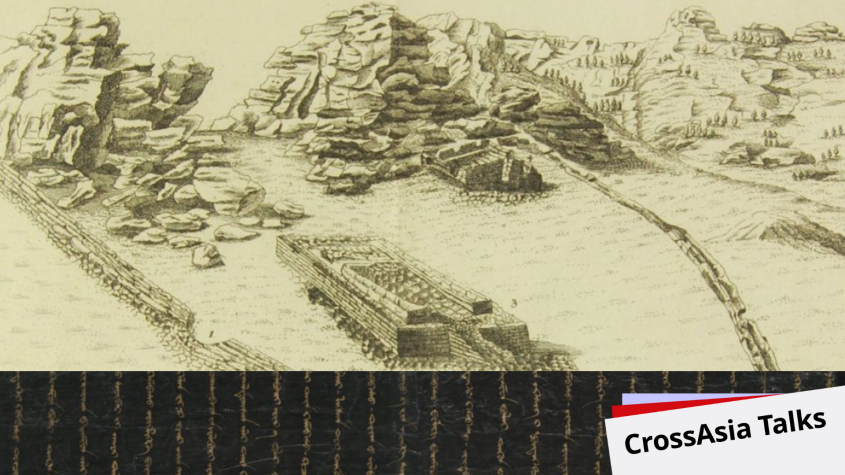
Between 1717 and 1721, two Oirat monasteries—usually called Sem Palat (Russian for “Seven Chambers”) and Ablai-kit—were encountered by Russian expeditions in what was then the frontier zone of Dzungaria and is now eastern Kazakhstan. The monasteries had been abandoned by the Oirats following internal conflicts, and most of their cultural treasures were lost. Only a small number of artefacts survived, among them approximately 1,500 folios of Buddhist texts in Tibetan and Mongolian.
While the largest portion of these materials is preserved in Saint Petersburg, several European institutions also hold folios originating from these monasteries. These manuscripts represent some of the earliest Tibetan and Mongolian texts to enter European collections. The Staatsbibliothek zu Berlin preserves a particularly notable group: 23 Mongolian and 23 Tibetan folios, almost all of them from Ablai-kit.
In this talk, we will trace the history of these manuscripts. In particular, they are connected with the work of German scholars of Asian languages, Johann Christoph Christian Rüdiger and Bernhard Jülg, as well as with the most influential historical Tibetan typeface, produced by Ferdinand Theinhardt for Heinrich August Jäschke’s Tibetan Dictionary (1881). We will also discuss the significance of these folios for the study of the Tibetan and Mongolian Buddhist canons.
Die Vortragssprache ist Englisch. Bei Fragen kontaktieren Sie uns unter: ostasienabt@sbb.spk-berlin.de.
Der Vortrag wird darüber hinaus via Webex gestreamt und aufgezeichnet*. Sie können am Vortrag über Ihren Browser ohne Installation einer Software teilnehmen. Klicken Sie dazu unten auf „Zum Vortrag“, folgen dem Link „Über Browser teilnehmen“ und geben Ihren Namen ein.
Alle bislang angekündigten Vorträge finden Sie hier. Die weiteren Termine kündigen wir in unserem Blog und auf Mastodon und BlueSky an.
—
We are delighted that on 23 April at 6 p.m., Dr. Anna Turanskaya (University of Inner Mongolia, Hohhot) and Dr. Alexander Zorin (Hebrew University of Jerusalem) will present new findings on the Mongolian and Tibetan Kanjurfolios from Ablai Kit in the Staatsbibliothek’s holdings in their online lecture „From Dzungaria to Berlin: Tibetan and Mongolian Folios in the Holdings of the Staatsbibliothek.“
Between 1717 and 1721, two Oirat monasteries—usually called Sem Palat (Russian for “Seven Chambers”) and Ablai-kit—were encountered by Russian expeditions in what was then the frontier zone of Dzungaria and is now eastern Kazakhstan. The monasteries had been abandoned by the Oirats following internal conflicts, and most of their cultural treasures were lost. Only a small number of artefacts survived, among them approximately 1,500 folios of Buddhist texts in Tibetan and Mongolian.
While the largest portion of these materials is preserved in Saint Petersburg, several European institutions also hold folios originating from these monasteries. These manuscripts represent some of the earliest Tibetan and Mongolian texts to enter European collections. The Staatsbibliothek zu Berlin preserves a particularly notable group: 23 Mongolian and 23 Tibetan folios, almost all of them from Ablai-kit.
In this talk, we will trace the history of these manuscripts. In particular, they are connected with the work of German scholars of Asian languages, Johann Christoph Christian Rüdiger and Bernhard Jülg, as well as with the most influential historical Tibetan typeface, produced by Ferdinand Theinhardt for Heinrich August Jäschke’s Tibetan Dictionary (1881). We will also discuss the significance of these folios for the study of the Tibetan and Mongolian Buddhist canons.
The lecture will be held in English. If you have any questions, please contact us: ostasienabt@sbb.spk-berlin.de.
The lecture will also be streamed and recorded via Webex*. You can take part in the lecture using your browser without having to install a special software. Please click on the respective button “To the lecture” below, follow the link “join via browser” (“über Browser teilnehmen”), and enter your name.
You can find all previously announced lectures here. We will announce further dates in our blog and Mastodon and BlueSky.
