
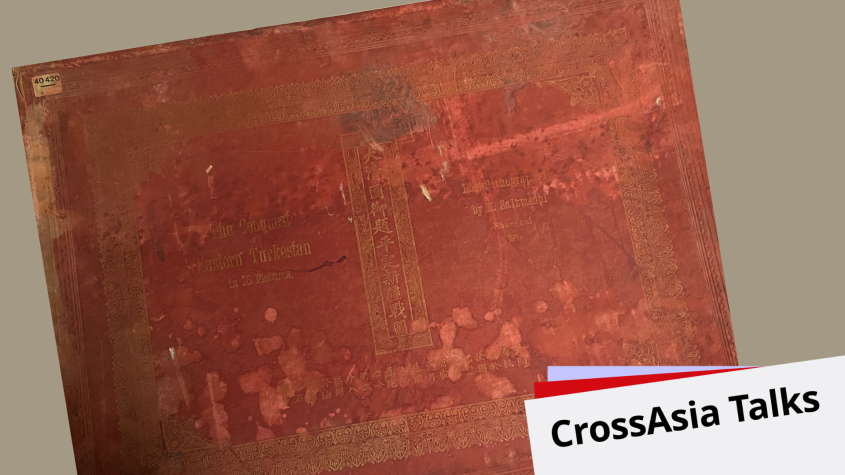
Resurfaced in our collection: The Lithographs of the East-Turkestan Engravings (Shanghai, 1891), originally printed in Paris between 1767 and 1774
(See English below)
Freuen Sie sich mit uns auf den 12. Feburar! Niklas Leverenz wird im Rahmen unserer CrossAsia Talks ab 18 Uhr zum Thema „Resurfaced in our collection: The Lithographs of the East-Turkestan Engravings (Shanghai, 1891), originally printed in Paris between 1767 and 1774“ referieren. Der Onlinevortrag behandelt ein kürzlich in der Sammlung der Staatsbibliothek wiederentdecktes Set photolithographischer Reproduktionen der ursprünglich in Paris angefertigten Schlachtenkupfer.
Reproductions of the famous East Turkestan engravings made in Paris around 1770 were printed in Shanghai in 1891 using the then new technology of photolithography. About twenty sets of these prints seem to exist, but very little is known about them.
The collection of the Staatsbibliothek zu Berlin owns one set of these unique prints which it acquired in 1965. The set was misplaced but could just recently be reallocated with the help of an article published by the speaker of this session, Niklas Leverenz, in the latest issue of the journal Orientations.
In this session, Niklas Leverenz will explain the historic background of the East Turkestan campaign in 1755-1760 which resulted in the subjugation of large territories in Central Asia that include much of the present-day Xinjiang Uyghur Autonomous Region. To celebrate his victory, the Qianlong emperor (r. 1735-1796) commissioned numerous artefacts, including sixteen monumental battle paintings, each measuring approximately four by eight metres. They were hung on the walls of the Ziguangge (Hall of Imperial Splendour) in the gardens to the west of the Forbidden City in Beijing.
Four Jesuit missionary painters working at the Qing court at the time drew reduced versions of these monumental battle paintings measuring c. 60 by 90 centimetres. These were to serve as model drawings for engravings to be made in France. The production of the sixteen conquest engravings in Paris between 1767 and 1774 attracted much public attention. One of these sets is known to have been in the Jesuit orphanage in Tushanwan, in the historically Catholic district of Shanghai, part of the area also called Xujiahui or Zikawei. This set was presumably the model for the photolithographic copies made by the German photographer Herman Salzwedel (active c. 1877–1904) in 1890.
The introduction of lithography in Shanghai in the late nineteenth century led to an increasing demand for images. From 1884 on the illustrated newspaper Dianshizhai Pictorial was published three times a month, successfully reproducing battle scenes from i.e. the Sino-French War. In this situation the Salzwedel print project was conceived.
Die Vortragssprache ist Englisch. Bei Fragen kontaktieren Sie uns unter: ostasienabt@sbb.spk-berlin.de.
Der Vortrag wird via Webex gestreamt*. Sie können am Vortrag über Ihren Browser ohne Installation einer Software teilnehmen. Klicken Sie dazu unten auf „Zum Vortrag“, folgen dem Link „Über Browser teilnehmen“ und geben Ihren Namen ein.
Alle bislang angekündigten Vorträge finden Sie hier. Die weiteren Termine kündigen wir in unserem Blog und auf unserem X-Account, Mastodon und BlueSky an.
—
On 12 February at 6 p.m., we look forward to an online lecture by Niklas Leverenz on the topic ‘Resurfaced in our collection: The Lithographs of the East-Turkestan Engravings (Shanghai, 1891), originally printed in Paris between 1767 and 1774’. The lecture will focus on a recently rediscovered set of photolithographic reproductions from the State Library’s collection, which were produced in Shanghai in 1891 based on Parisian copperplate engravings of the Qianlong conquest campaigns.
Reproductions of the famous East Turkestan engravings made in Paris around 1770 were printed in Shanghai in 1891 using the then new technology of photolithography. About twenty sets of these prints seem to exist, but very little is known about them.
The collection of the Staatsbibliothek zu Berlin owns one set of these unique prints which it acquired in 1965. The set was misplaced but could just recently be reallocated with the help of an article published by the speaker of this session, Niklas Leverenz, in the latest issue of the journal Orientations.
In this session, Niklas Leverenz will explain the historic background of the East Turkestan campaign in 1755-1760 which resulted in the subjugation of large territories in Central Asia that include much of the present-day Xinjiang Uyghur Autonomous Region. To celebrate his victory, the Qianlong emperor (r. 1735-1796) commissioned numerous artefacts, including sixteen monumental battle paintings, each measuring approximately four by eight metres. They were hung on the walls of the Ziguangge (Hall of Imperial Splendour) in the gardens to the west of the Forbidden City in Beijing.
Four Jesuit missionary painters working at the Qing court at the time drew reduced versions of these monumental battle paintings measuring c. 60 by 90 centimetres. These were to serve as model drawings for engravings to be made in France. The production of the sixteen conquest engravings in Paris between 1767 and 1774 attracted much public attention. One of these sets is known to have been in the Jesuit orphanage in Tushanwan, in the historically Catholic district of Shanghai, part of the area also called Xujiahui or Zikawei. This set was presumably the model for the photolithographic copies made by the German photographer Herman Salzwedel (active c. 1877–1904) in 1890.
The introduction of lithography in Shanghai in the late nineteenth century led to an increasing demand for images. From 1884 on the illustrated newspaper Dianshizhai Pictorial was published three times a month, successfully reproducing battle scenes from i.e. the Sino-French War. In this situation the Salzwedel print project was conceived.
The lecture will be held in English. If you have any questions, please contact us: ostasienabt@sbb.spk-berlin.de.
The lecture will be streamed via Webex*. You can take part in the lecture using your browser without having to install a special software. Please click on the respective button “To the lecture” below, follow the link “join via browser” (“über Browser teilnehmen”), and enter your name.
You can find all previously announced lectures here. We will announce further dates in our blog and on X, Mastodon and BlueSky.

