
Gastbeitrag von Luca Di Nardo
What can an old catalogue card still tell us in the age of digital libraries? At first glance, the catalogue cards preserved in the Neue Systematische Katalog (NSyK) of the Staatsbibliothek zu Berlin seem to belong to a world that has long since disappeared. Before online catalogues, they guided generations of researchers through the library’s collections. Today, however, they are much more than obsolete finding aids. They are historical objects that preserve traces of librarians‘ work, institutional decisions, research practices and even the passage of time itself.
During my three-month post-doc research fellowship at the Staatsbibliothek zu Berlin, I explored a small section of the Neue Systematische Katalog with a simple question in mind: what do these catalogues’ cards preserve as part of the library’s cultural heritage? And which of their features should be taken into account in a future digitisation project?
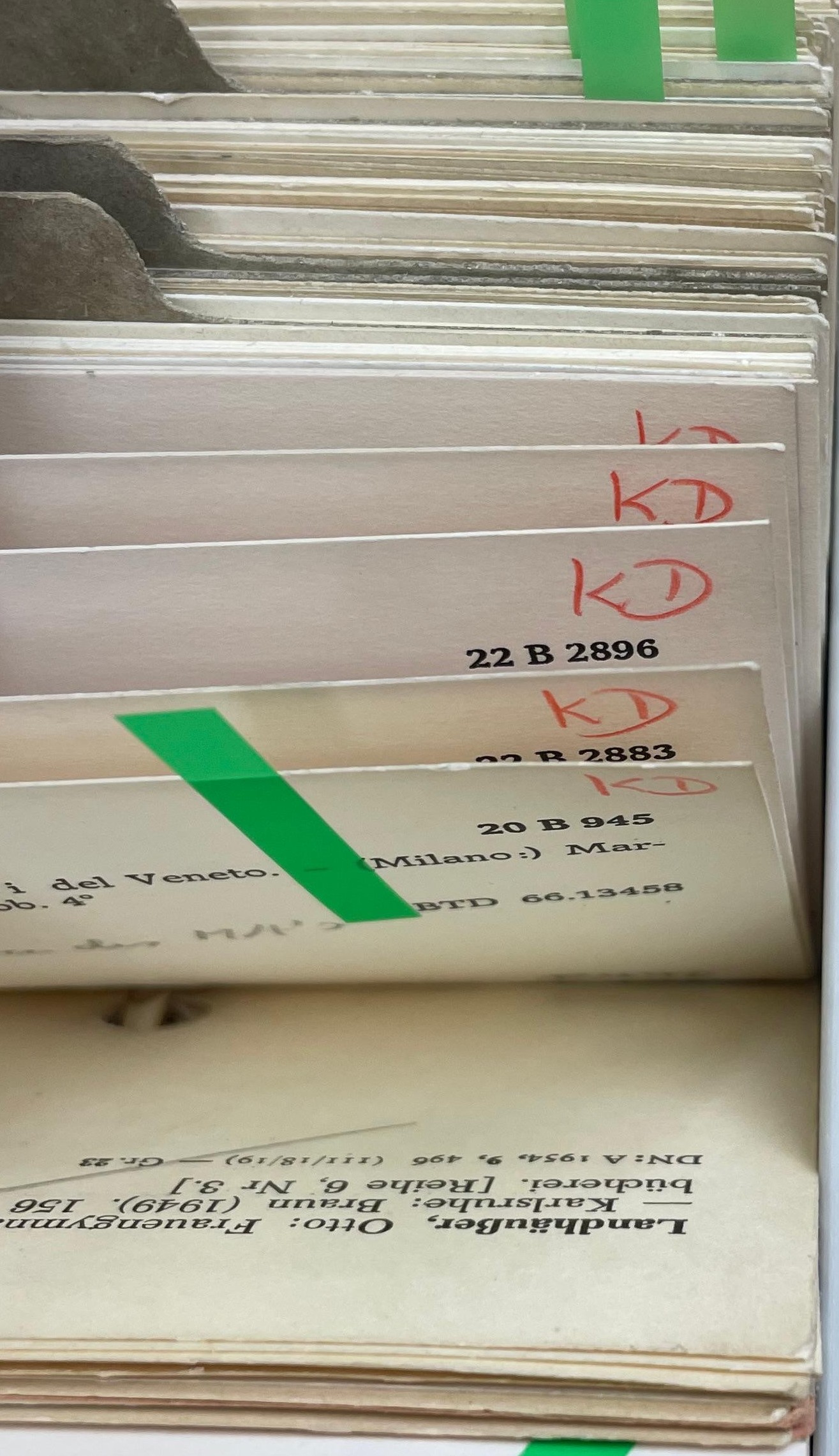
Fig. 2: Close-up of the handwritten „KD“ (Künstlerische Drucke). Description: A series of Zettel with the abbreviation „KD“ (Künstlerische Drucke, „artistically designed, illustrated printed books“) handwritten in red pencil in the upper-right corner of the cards; Neue Systematische Katalog (NSyK) 1004, Romanistik (Rom), Italienische Literatur (P). Photo by Luca Di Nardo
Rather than treating each card merely as a bibliographic record, I approached it as a layered document whose physical appearance, annotations and position within the catalogue contribute to telling a much richer story. The Neue Systematische Katalog documents the holdings acquired by the Deutsche Staatsbibliothek between 1956 and 1991, during the existence of the German Democratic Republic. Containing approximately one million catalogue cards, it records literature from a wide range of scholarly disciplines and reflects the collecting policies of one of the GDR’s most important research libraries. Beyond its practical function, the Neue Systematische Katalog also represents a remarkable historical source. Alongside legal deposit copies from East Germany, it includes publications from Eastern Europe, Western Europe and the United States.
For my research, I concentrated on the both Italian literature and language section of the Romance Studies drawers (NSyK, Romanistik, Kästen: 1003, 1004, 1005, 1006) using this limited corpus as a case study to investigate broader questions concerning the preservation and interpretation of historical card catalogues.
Every Zettel (catalogue card) contains the essential bibliographic description of a book. Yet careful observation soon revealed that these small pieces of paper preserve much more than bibliographic data. Throughout the project, I began referring to these additional traces as “lost information” – not because they have already disappeared, but because they could easily be overlooked if attention is focused exclusively on the main bibliographic record.
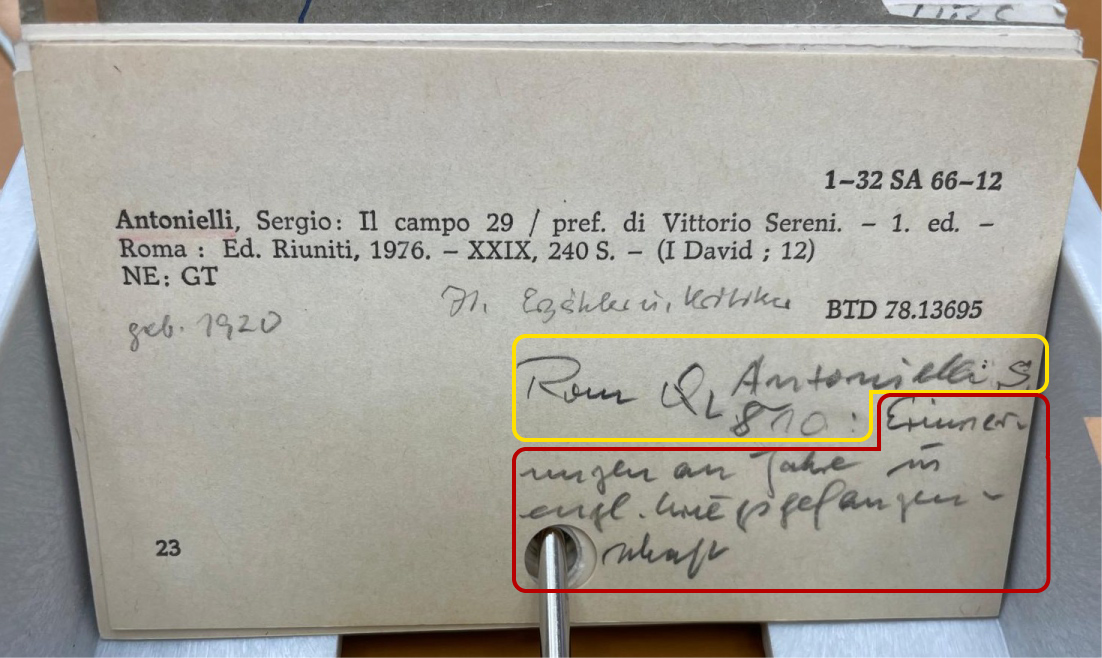
Fig. 3: Zettel for Sergio Antonielli. Description: Zettel for Sergio Antonielli’s *Il campo 29*, Roma : Ed. Riuniti, 1976; Shelf Mark: 32 SA 66-12; Neue Systematische Katalog (NSyK) 1005, Romanistik (Rom), Italienische Autoren A-F (Q). Particular: Lower-right corner: Handwritten pencil note, highlighted with a red circle by the author: “Erinnerungen an Jahre in englischer Kriegsgefangenschaft” (Memoirs of the years spent in an English prisoner-of-war camp). Handwritten pencil note, highlighted with a yello color by the author of this article „Rom, Q, Antonielli“. https://stabikat.de/Record/434974714. Photo by Luca Di Nardo
One of the first Zettel that caught my attention described Sergio Antonielli’s Il campo 29 (cf. Fig. 3 and its description). Written in elegant cursive handwriting, it included, in the lower-right corner, the note Erinnerungen an Jahre in englischer Kriegsgefangenschaft (Memoirs of the years spent in an English prisoner-of-war camp, cf. Fig. 3), a brief summary of the book’s content. Reading this short annotation was unexpectedly moving. It made me realise that my research should focus precisely on what extended beyond the main bibliographic description. From that moment on, the outer layers of the catalogue card became the central object of my investigation. To identify these layers, I systematically examined the catalogue cards, consulted historical cataloguing instructions and compared the NSyK with other catalogues preserved at the Staatsbibliothek, including Alphabetischer Katalog I (AK I), Alphabetischer Katalog II (AK II) and the Alter Realkatalog (ARK). The first two are Zettelkataloge (card catalogues) available in the Venedig reading room on microfiche, while the ARK, consisting of over 1800 thematic volumes and describing the historical holdings from 1501 to 1955, can only be consulted by library staff, due to its unique importance and fragility, in the Alexandria reading room (Der Alte Realkatolog). I also compared the cards with the records in today’s online catalogue, StabiKat. This work gradually revealed a remarkable and meaningful stratification. Handwritten annotations, acquisition dates, institutional stamps, censorship marks, abbreviations indicating particular access or storage conditions, corrections added over decades and even the physical arrangement of the cards all contribute to documenting the history of the catalogue and the work of the librarians who created and maintained it. However, these layers of information are not included in StabiKat. This is precisely why studying and consulting the Zettelkataloge themselves remains so important: they preserve information that cannot be found in the online catalogue.
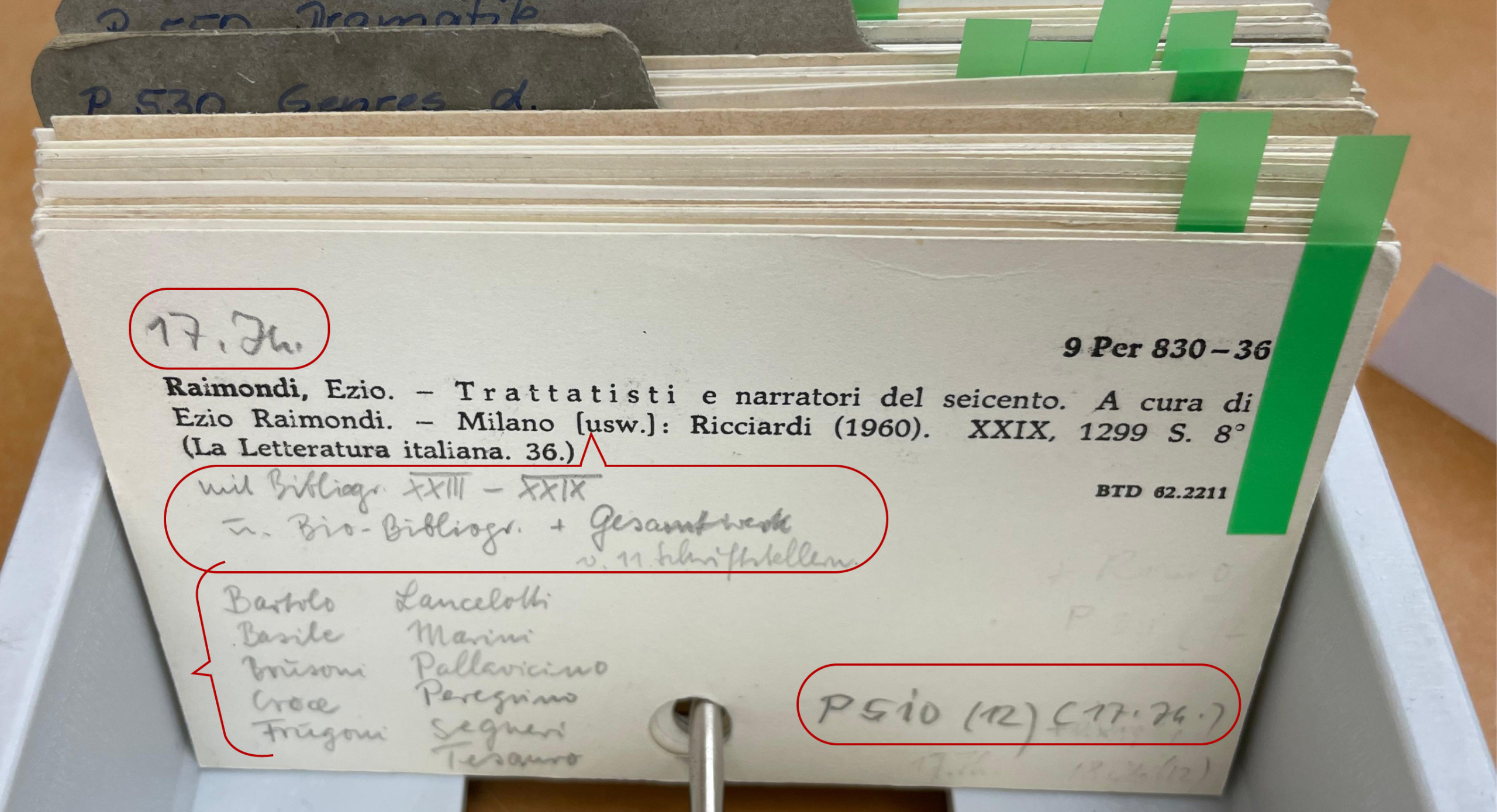
Fig. 4: Zettel for Ezio Raimondi’s Trattatisti e narratori del Seicento. , a cura di Ezio Raimondi, Milano \[u.a.] : Ricciardi, 1960; Shelf Mark: 9 Per 830-36; Neue Systematische Katalog (NSyK) 1004, Romanistik (Rom), Italienische Literatur (P). Particular: Pencil annotations on the Zettel: “17. Jh.” (17th century); “Mit Bibliogr. XXIII–XXIX” (bibliography on pp. XXIII–XXIV); “u. Bio-Bibliogr. + Gesamtwerk” (bio-bibliography and collected works); “von 11 Schriftstellern ” (by 11 authors); in the lower-left section, an alphabetical list of the authors included in the anthology (Bartoli, Basile, Brusoni, Croce, Frugoni, Lancellotti, Marini, Pallavicino, Peregrini, Segneri, Tesauro); and, in the lower-right corner, “P 510 (12) (17. Jh.)” (Italian literature of different periods of the 17th century). https://stabikat.de/Record/022138668. Photo by Luca Di Nardo
As I focused increasingly on this additional information, one Zettel in particular caught my attention. It was the catalogue card for Die Gespräche by Pietro Aretino (cf. Fig. 5 and its description). Seeing this Renaissance Italian masterpiece – originally published in the early sixteenth century and well known for its deeply critical and ironic nature – in a 1978 edition reprinted by the Zentralantiquariat of the GDR immediately prompted me to investigate it more closely.
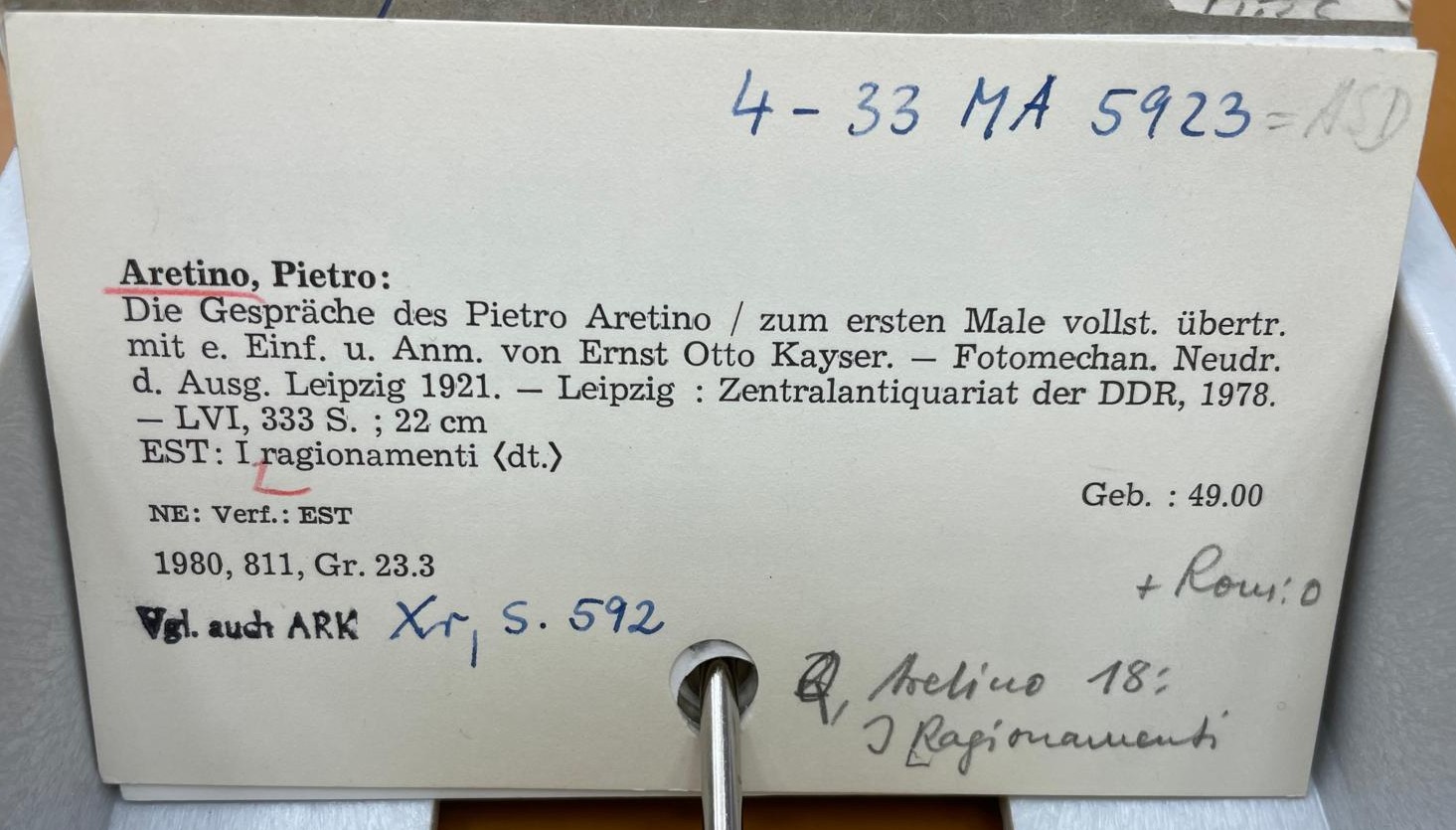
Fig. 5: Zettel for Pietro Aretino’s *Die Gespräche des Pietro Aretino. Leipzig : Zentralantiquariat der DDR, 1978; Shelf Mark: 4-33 MA 5923; Neue Systematische Katalog (NSyK) 1005, Romanistik (Rom), Italienische Autoren A-F (Q). Particular: Red-pencil underline under the author’s surname; shelf mark handwritten in light blue ink, followed by “ASD” (Abteilung für Seltene Drucke, Department of Rare Books); red-pencil mark next to the Italian title; lower-left corner: stamp “Vgl. auch ARK Xr. S. 592” (compare Alte Realkatalog, vol. Xr, p. 592); Lower-right corner: handwritten in pencil, “Rom” (Romanistik), “Q” (Italian authors), and the author and title in Italian (“Aretino, I Ragionamenti”). https://stabikat.de/Record/434991309. Photo by Luca Di Nardo
The Zettel contains intriguing details. First of all, the shelf mark is written in blue ink, which appears to have been used again at the bottom of the card to indicate the corresponding entry in another catalogue, namely the Alter Realkatolog (ARK).
Indeed, the stamp Vgl. auch ARK directs the reader to compare the entry with the ARK under the reference Xr, S. 592 (cf. Fig. 5 and its description). Another detail immediately caught my eye. In the upper right-hand corner of the card, a faint pencil abbreviation ASD is still visible. After consulting documentation made available by my colleagues, I discovered that the abbreviation stands for Abteilung für Seltene Drucke (Department of Rare Books). This indicated that the volume, acquired by the library around 1980, had at some point been assigned to the Department of Rare Books (Cf. Fig. 5). Why? That simple question led me further. I requested the book itself and decided to check whether the same detail also appeared in the ARK. While waiting for the volume to arrive, I discovered that, according to the cataloguing criteria of the time, the abbreviation ASD could also refer to publications belonging to a collection of artistically significant printed works. The investigation, almost like an archaeological excavation, was becoming increasingly fascinating. When the book finally arrived, everything suddenly made sense – or, at least, this is how I interpreted the evidence before me.
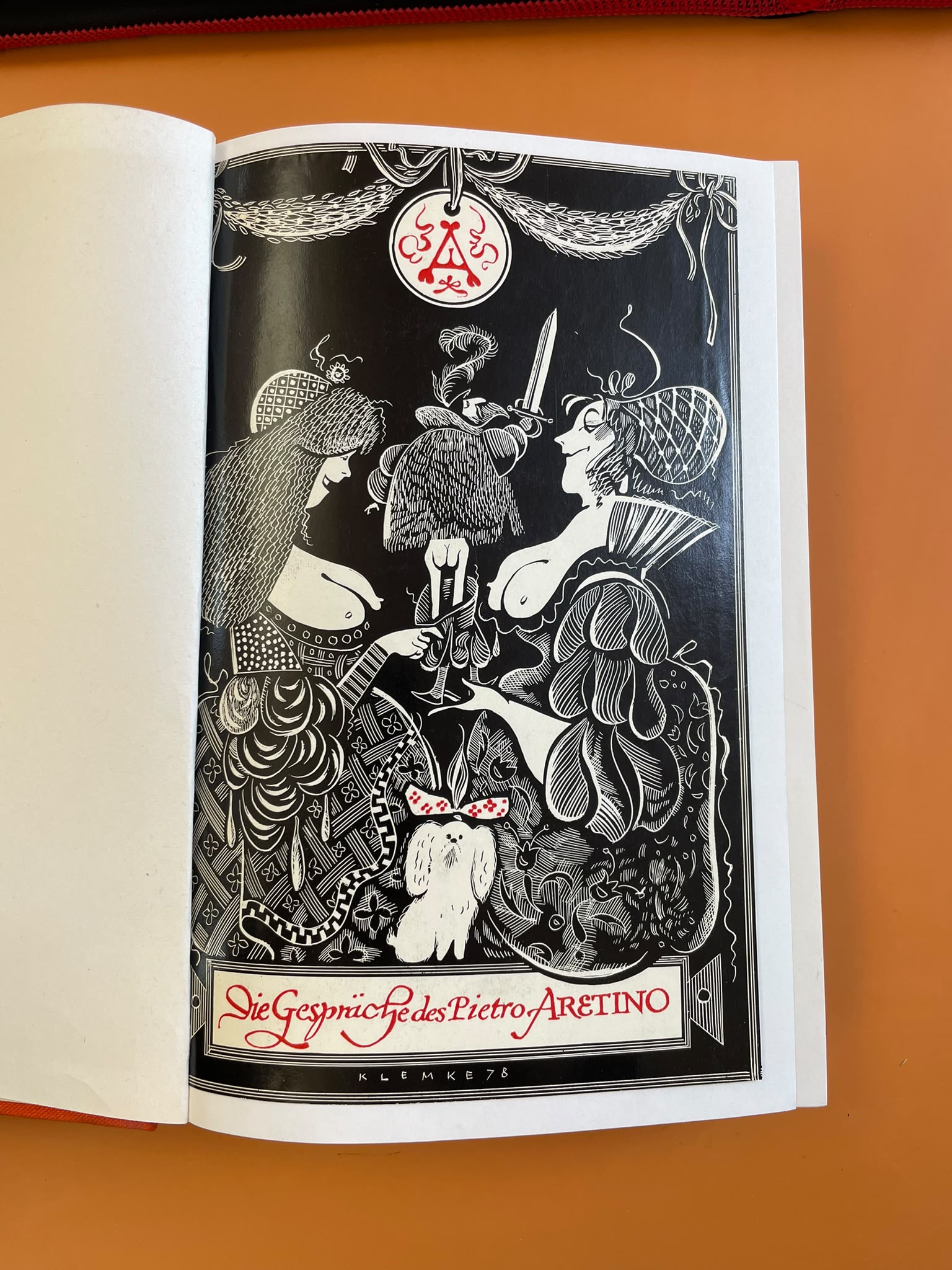
Fig. 6: Frontispiece drawn by Werner Klemke for Pietro Aretino’s *Die Gespräche des Pietro Aretino* (cf. Illustration 5). Description of the illustration: Frontispiece drawn by Werner Klemke in 1978; “Klemke 78” (Klemke 1978) visible at the bottom. https://stabikat.de/Record/434991309. Photo by Luca Di Nardo
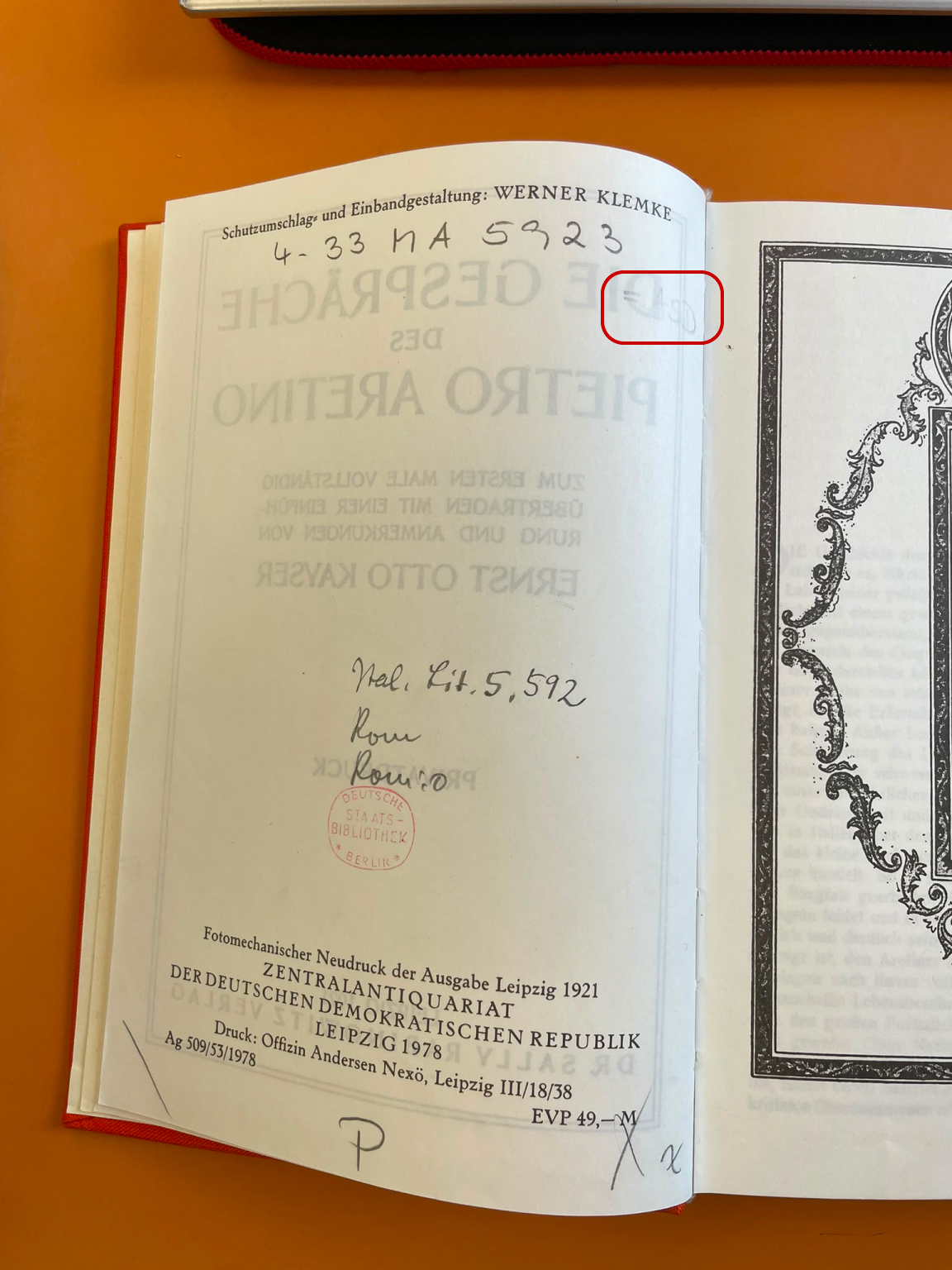
Fig. 7: Endpaper of Pietro Aretino’s *Die Gespräche des Pietro Aretino* (cf. Illustration 5). Particular: Upper section: Schutzumschlag und Einbandgestaltung: Werner Klemke (Dust jacket and binding design by Werner Klemke), shelf mark followed by the faded “ASD” (Abteilung für Seltene Drucke, Department of Rare Books), recorded on the Zettel but not in StabiKat and circled in red by the author; bottom: “Ital. Lit. S. 592” (Italian literature, p. 592), handwritten in pencil and referring to the Alte Realkatalog (cf. Illustration 5); “Rom” (Romanistik) and red Deutsche Staatsbibliothek Berlin (DSB) stamp. Photo by Luca Di Nardo
The volume proved to be a reprint of the 1921 German edition (cf. Fig. 7). The abbreviation ASD also appeared on the front endpaper (cf. Fig. 7) confirming a consistent cataloguing practice. Before the title page, however, I found something unexpected: a beautiful illustration (cf. Fig. 6) summarising the content of the book, created by the illustrator Werner Klemke, a prominent figure in the cultural life of the GDR and a close friend of Horst Kunze, Director General of the Deutsche Staatsbibliothek from 1950 to 1977. The illustration depicts two cheerful, scantily dressed women looking down at a much smaller man whose trousers are being pulled down by the younger of the two women, leaving him visibly embarrassed and ridiculed (cf. Fig. 6). It perfectly captures the spirit of Aretino’s work, in which the two women, Nanna and Antonia, discuss the different roles available to women in society – the nun, the wife and the courtesan – with irony and remarkable freedom.
According to the library’s cataloguing policy of the time, the volume was assigned to the collection of artistically significant printed works, most likely because of Werner Klemke’s illustration, before later being reintegrated into the general collection. The ARK preserves the same pencil abbreviation ASD together with the same blue-ink shelf mark (33 MA 5923, cf. Fig. 8), providing further evidence of this internal cataloguing harmonisation. The same page of volume Xr of the ARK also record earlier editions of Aretino acquired by the Berlin library, including editions from 1903 and 1921, as well as a second copy of this edition. Interestingly, unlike the 1978 reprint (shelf mark: 33 MA 5923), these earlier editions were marked as secretiert (cf. Fig. 8).
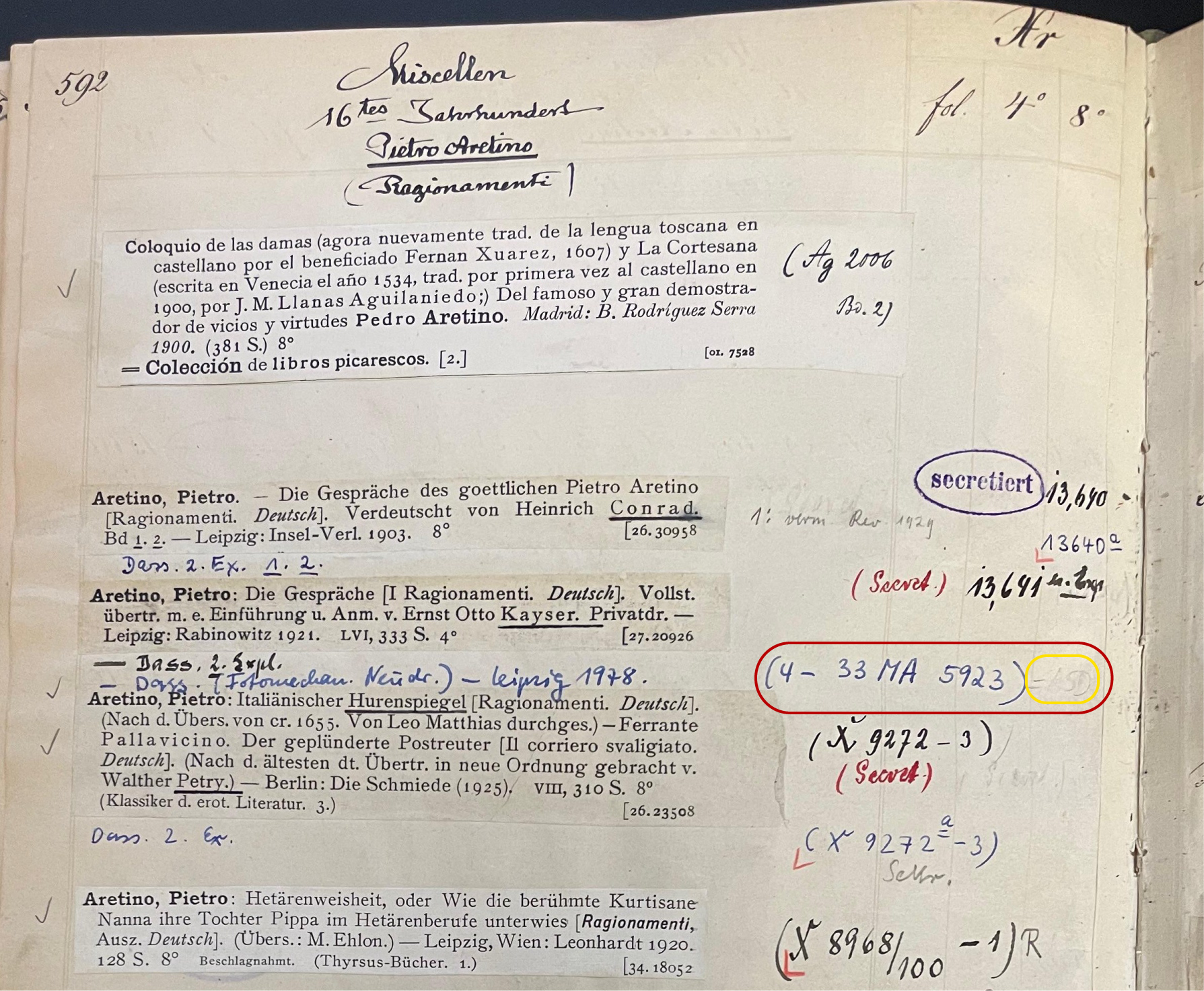
Fig. 8: ARK Xr. S. 592 (Alte Realkatalog, vol. Xr, p. 592, cf. Illustration 5). Description: ARK page containing the entry for Pietro Aretino’s Die Gespräche des Pietro Aretino (shelf mark: 4-33 MA 5923), to which the stamp on the Zettel refers for comparison (cf. Illustration 5); reference to the Zettel shelf mark highlighted and circled in red by the author of this article; earlier editions held by the library marked as “secretiert” (restricted). Photo by Luca Di Nardo
This example illustrates one of the central ideas of my research. What initially appears to be a minor graphic detail can suddenly open unexpected connections with the cultural history of the GDR, artistic production, institutional practices and the history of the library itself. Looking carefully at a single catalogue card often means discovering that it preserves far more than bibliographic information.
This is what I wanted to convey through the image of the “triangle of knowledge” presented in the title of this article: Zettel – Book – Alternative Catalogue, whether analogue or digital. In every case, it is the Zettel that triggers this trajectory of discovery. From that moment on, I began paying particular attention to the upper right-hand corner of the catalogue cards, recognising it as a place where something special was often preserved, even if not always of immediate importance (cf. Fig. 2 and Fig. 5). This approach reveals the historical content embedded in the catalogue and highlights the importance of studying it before transforming it into a digital environment designed for consultation and research.
Working with the NSyK gradually changed my own way of looking at catalogue cards. Instead of seeing them merely as technical tools, I began to think of them as texts – or, borrowing the Latin word textum, as woven structures in which different layers of information intersect. This perspective recalls the working methods adopted by important scholars such as Niklas Luhmann and Aby Warburg, both of whom regarded paper slips and personal card-index systems not simply as repositories of information but as instruments capable of generating relationships between ideas.
Something similar happens when consulting the NSyK. Following cross-references, moving physically from one drawer to another and encountering unexpected neighbouring entries often leads the researcher beyond the initial search. Rather than interrupting the research process, these detours stimulate curiosity and imagination. One almost has the impression of getting pleasantly lost inside the catalogue, allowing unexpected connections to emerge. In this sense, the NSyK is not only a system for locating books but also a system that encourages discovery.
The NSyK is definitely part of the cultural heritage preserved by the Staatsbibliothek zu Berlin – Preußischer Kulturbesitz. Its catalogue cards document not only books, but also the history of librarianship, scholarly research and the organisation of knowledge during a crucial period of German history. Preserving these layers means preserving more than data. It means safeguarding the memory of how knowledge was organised, transmitted and experienced.
A study of this kind could provide a solid scholarly foundation for the development of a digital environment designed to preserve the library’s historical card catalogues.
Dr. Luca Di Nardo war im Rahmen des Stipendienprogramms der Stiftung Preußischer Kulturbesitz im Jahr 2026 als Stipendiat an der Staatsbibliothek zu Berlin.
Forschungsprojekt: Lost in Digitization: Zettelkatalog as ‚Small Forms‘ of Cultural Memory at the Staatsbibliothek zu Berlin.
Seit Oktober forscht er im gemeinsamen 4A_Lab-Stipendienprogramm des Kunsthistorischen Instituts in Florenz – Max-Planck-Institut und der Einrichtungen der Stiftung Preußischer Kulturbesitz zum Thema: Intellectual Ordering Systems in the Card Catalogues of the Berlin State Library.

