
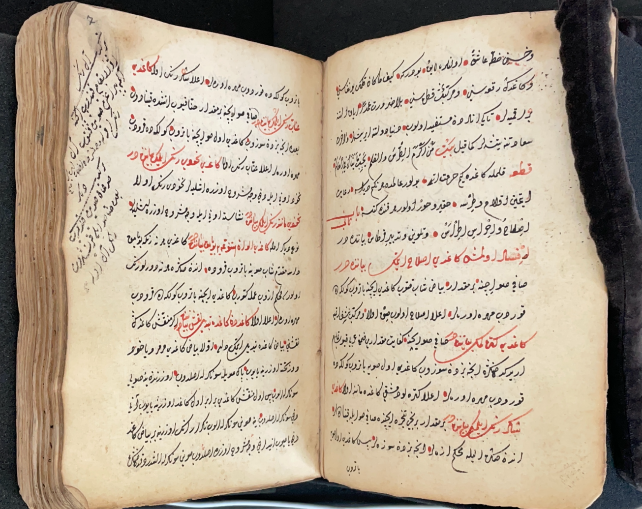
16th – 17th Century Manuscripts and Letter-Writing Manuals in the Staatsbibliothek zu Berlin
Als Gastbeitrag von Dr. Ercan Akyol: Auszüge aus seinem Beitrag im Blog des DFG-Projekts Qalamos
The primary objective of my research is to contextualize Ottoman literary culture of the late 16th and early 17th centuries within its historical framework, with a particular focus on the
functions of literature in Ottoman society, especially among the scholarly elite. In my doctoral dissertation, I had examined the literary-intellectual milieu of the period utilizing as broad a range of materials as possible. Letters, archival documents, chronicles, travelogues, medical treatises, biographies (teẕkire), and various literary works served as the primary sources for my research. My forthcoming book, which builds upon and extends my PhD thesis, focuses on Ottoman epistolary guides in manuscript. [These] relate also to my broader study of letter-writing practices in the early modern period.
During my stay at the Oriental Department, by using Qalamos I found and personally examined 155 Ottoman manuscripts from the 16th and 17th centuries, spanning a wide range of content and material qualities. These included manuals of correspondence, literary works, chronicles, texts on agriculture, books on legal codes, fetvā & ṣakk collections, personal compilations, works on physiognomy, fortune-telling guides, works on sexual health, religious treatises, dictionaries, and story collections.
The benefits of my study extended beyond the manuscript contents, which alone constituted an invaluable resource. The opportunity to closely examine the manuscripts themselves allowed me to gain deeper insights into their material and codicological features.
As to epistolary manuals, I believe I have thoroughly examined nearly all the relevant material available in the library’s Oriental collection, covering manuscripts from the 16th century through to the late 19th century. The Berlin collection includes personal letter collections and mixed-content manuscripts that belonged to many individuals who served in the Ottoman scribal service, particularly from the 18th century onward. This material holds enormous potential for future research. Although my primary focus lies in earlier centuries, I intentionally explored manuscripts from later periods as well with the objective to gain a broader perspective on the development of letter-writing manuals over time. This approach allowed me to obtain significant insights into the evolution of these manuals across temporal, spatial, and social contexts, and to trace their transformation through various manuscripts.
In this way, I have identified previously unknown or unpublished letters and uncovered information within them that will contribute to establishing new historical contexts.
Analyzing these letter compilations collectively, spanning various centuries, diverse contents, and material characteristics, and authored by individuals from different social strata, offers a valuable macro perspective on their forms and purposes, methods of drafting, calligraphic preferences, evolving contents, material features, vocabulary, patterns of ownership, and their broader circulation – far beyond what is discussed in the existing literature.
These manuals, in essence, functioned as “tools” designed to meet the professional and intellectual communication needs of the scholarly and scribal classes, as well as other letter-writers from different walks of life. The repository of refined language and pre-formulated phrases provided by letter-manuals facilitated effective communication.
Both the content and the calligraphy of letter collections were influenced by the position of the individuals composing or using them. Thanks to the extensive collection of letter manuscripts housed in the Staatsbibliothek, my research in Berlin provided valuable insights into how these conventions were established.
At this point, one might wonder why so many letter-writing manuals ended up in [the] Berlin library. The explanation is straightforward: they were collected to facilitate the understanding of official Ottoman correspondence.
Herr Dr. Ercan Akyol, Universität Wien, war im Rahmen des Stipendienprogramms der Stiftung Preußischer Kulturbesitz im Jahr 2024 als Stipendiat an der Staatsbibliothek zu Berlin. Forschungsprojekt: „Osmanische literarische Kultur im frühen 17. Jahrhundert: Ein Versuch der Kontextualisierung der osmanischen literarischen Vergangenheit“
Den vollständigen Beitrag finden Sie im Blog des DFG-Projekts Qalamos.
 Bildausschnitt: Aquarell Breslau, Zuchthaus. Aus: Stridbeck, Johann: Skizzenbuch : Ms. boruss. qu. 9a , 1691. SBB-PK
 Public Domain
 akg-images / Universal Images Group / For Education Use Only
 . Photo: Ⓒ Linn Ahlgren/Nationalmuseum
 SBB-PK CC BY-NC-SA 3.0
Ihr Kommentar
An Diskussion beteiligen?Hinterlassen Sie uns einen Kommentar!