
Music in Non-Musical Medieval Manuscripts
Gastbeitrag von Paweł Gancarczyk
Today, a book is usually understood as a coherent whole united under a single title. In the Middle Ages, however, this was often not the case. A single manuscript could contain numerous texts of widely differing content. These texts might have been copied by different scribes, at different times, and in different places. Initially, they were copied into small booklets or gatherings, which were only later assembled into a larger volume bound within a single cover. At a time when libraries were far smaller than they are today and paper was a valuable commodity, such a manuscript could function as a kind of one-volume library. A medieval student, teacher, or preacher could gather within it everything considered useful or intellectually interesting for study and professional work.
As a result, one often encounters texts side by side that appear to have little in common. Treatises on astronomy may stand next to collections of model letters, while a text on the expulsion of demons follows a description of Latin grammar. Hidden within these one-volume collections one may sometimes also find musical notation. Music was taught already at the elementary-school level, since schoolboys were expected to sing during church services. At universities, students studied music theory as part of the quadrivium, and in some cases also acquired practical skills such as reading musical notation and composing simple pieces. Universities also taught poetics, the art of composing verse, which was closely connected with the creation of songs.
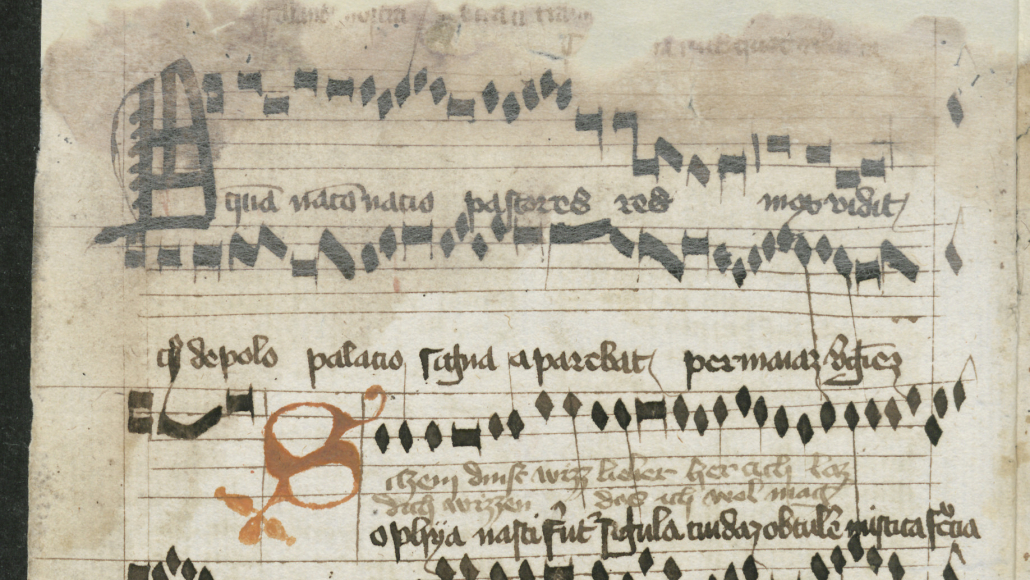
While working with the collection of Western manuscripts in the Staatsbibliothek, I identified several fifteenth-century non-musical manuscripts containing musical additions, some of which have so far escaped the attention of musicologists. I was particularly interested in polyphonic music written in mensural notation (see Figure 1), since this type of repertory required considerably greater expertise than the singing of hymns or antiphons in the liturgy. My research revealed that intellectuals from cities such as Brunswick (Braunschweig), Hildesheim, and Osnabrück developed a particular interest in composing polyphonic Latin songs, or cantiones. These works display a highly characteristic set of features, including a bipartite structure and elaborate opening melismas. Similar songs were cultivated across many parts of Central Europe, especially in Bohemia, Poland, and Austria, and their stylistic models were developed at the University of Prague toward the end of the fourteenth century. Through the mobility of students and masters, this musical tradition eventually reached the University of Erfurt, the most important intellectual centre for Thuringia, Hessen, and Lower Saxony. As a consequence, music in Germany was composed according to the same principles that shaped musical culture in the more eastern regions of Europe.
The themes of these songs are usually devotional or moralizing in nature. Among the most common subjects are Christmas and praise of the Virgin Mary. Particularly fascinating, however, is the presence of acrostics in many of the texts. An acrostic is a literary device in which words—most often the author’s name—are encoded within a text. For example, if a song consisted of nine stanzas, the first letters of each stanza might spell out a name such as Johannes or Leonardus. Through such acrostics, I was able to identify several previously unknown authors hidden within the manuscripts. This was not always easy, especially given the difficulty of deciphering fifteenth-century handwriting. The task was further complicated by the frequent mixing of Latin with Middle Low German (mittelniederdeutsch) in manuscripts from Lower Saxony.
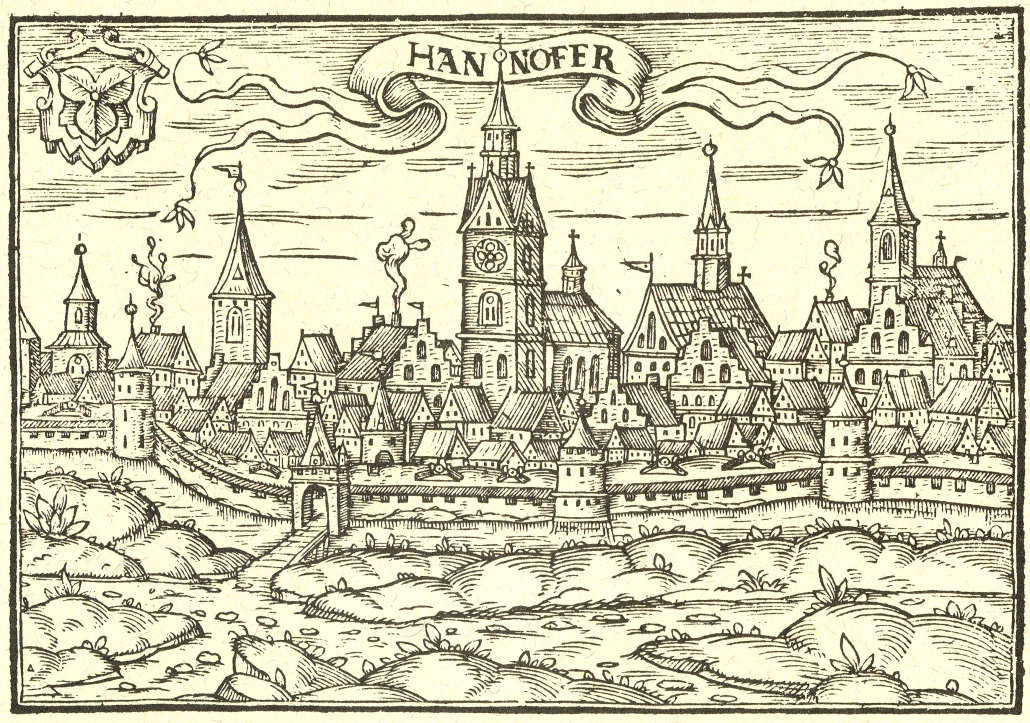
Fig. 2: Hanover around 1585, a woodcut by Heinrich Bünting from “Braunschweigische und Lüneburgische Chronica, II”. Public domain.
Another particularly striking discovery was that polyphonic songs were also used in Lower Saxony to praise local cities. Surviving works celebrate Hanover and Brunswick, two cities whose fifteenth-century musical life remains largely unknown. According to the texts of these songs, their citizens are pious, wise, and virtuous, while the cities themselves are portrayed as earthly paradises. Hanover, for example, is described as “perfectly situated among forests” and adorned with “beautifully shaped towers” (see Figure 2). A modern composer producing such a work today would likely risk ridicule. In the fifteenth century, however, songs served not only as vehicles for devotion or entertainment, but also as demonstrations of rhetorical skill and learning. One of the two surviving songs praising Hanover strikes me as particularly successful from a musical point of view, and I hope it may soon be performed by an ensemble specializing in early music. Unfortunately, the author did not leave an identifying acrostic, and so, like most fifteenth-century compositions, the work remains anonymous.
My research at the Staatsbibliothek zu Berlin was made possible through a fellowship from the Stiftung Preußischer Kulturbesitz. The results of this research will be presented in a forthcoming publication.
Prof. Dr. Paweł Gancarczyk, Institute of Art, Polish Academy of Sciences Warschau, war im Rahmen des Stipendienprogramms der Stiftung Preußischer Kulturbesitz im Jahr 2026 als Stipendiat an der Staatsbibliothek zu Berlin.
Forschungsprojekt: Additamenta musica: Polyphony in Non-Musical German Manuscripts from the Fifteenth Century

 Wissenswerkstatt SBB-PK CC BY-NC-SA 3.0
 Photo: Lukáš Kubík
 CC-BY-NC-SA 3.0
 Public Domain
 SBB-PK On 6700


Ihr Kommentar
An Diskussion beteiligen?Hinterlassen Sie uns einen Kommentar!